Games Studies【Weekly Learning】
Games Studies
Week 1/ Introduction to Game Studies class
Week 2/ Game framework conceptualization process
Week 3/ Learning Through Board Game Exploration
Week 4/ Overcoming Design Challenges
Week 5/ Presentation
Week 6/ Try to play
Week 7/ Mutual Learning and Card Iteration
Week 8/ Improve the map
Week 9/ Online class
Week 10/ Noclass schedule
Week 11/ Optimize the game machanics
Week 12/ Game playtest and find weakness
Week 13/ Improve game and playtest it angin
Week 14/ Presentation
WEEK1:
Introduction to Game Studies class
Today's Game Studies class began with an energetic introduction by Ms. Noranis. She presented the semester's syllabus in such an engaging and humorous manner that the whole class was immersed in a joyful learning atmosphere.
Later, another professor delivered an insightful session on "Simplifying Complex Processes". Using the biological process of glycogen converting into energy as an example, he demonstrated simplification techniques including:
- Replacing jargon with everyday language
- Omitting non-essential steps
- Highlighting key conversion points

The professor emphasized that since games target general audiences, "accessibility" and "entertainment value" are golden rules of design. During the interactive session, Mr. guided us to transform this biochemical process into game mechanics: Energy storage threshold as win condition,Energy absorption as scoring mechanism,Enabling players to grasp physiology through gameplay。
She asked us to form a group of five people ourselves and complete the assignments together:

WEEK2:
Game framework conceptualization process
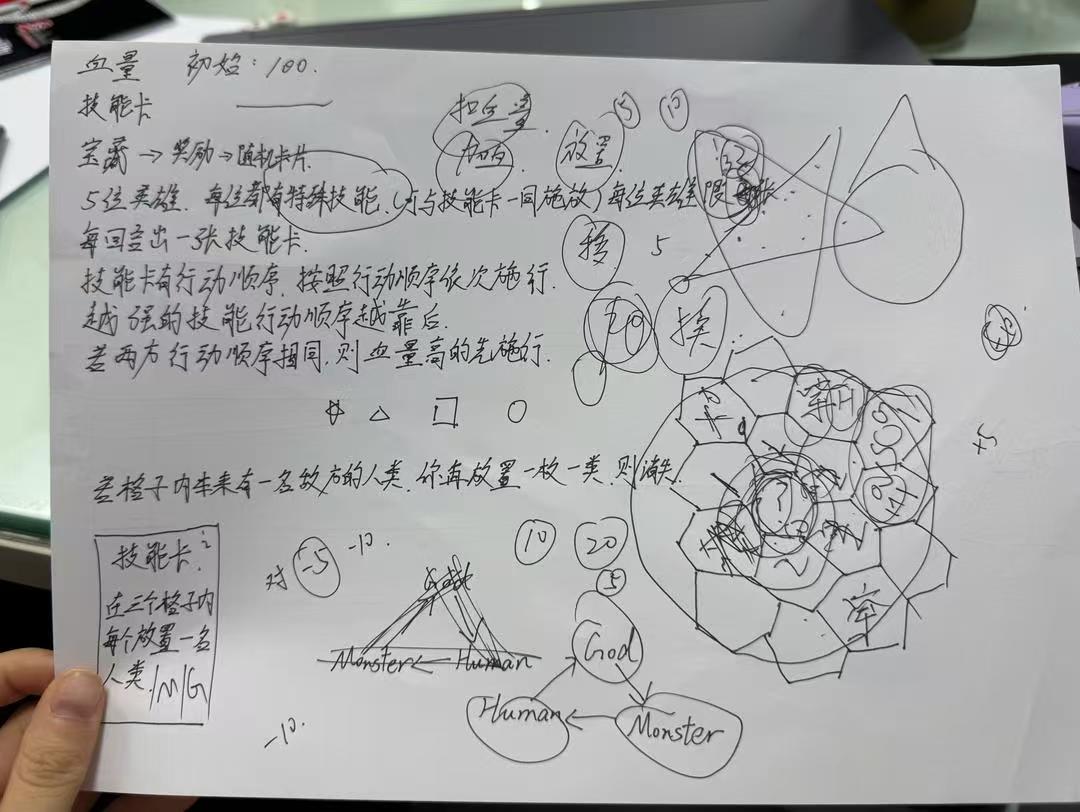
In today's class, the teacher asked us to design the basic framework and core gameplay of a game.At first we were a bit clueless, after all, this is a brand new field for us.After some discussion, we decided to refer to the structure of the classic board game Warhammer 40,000 for inspiration.
Our initial plan is that the game contains five camps, each with unique skills and tactical styles.The victory conditions not only depend on the player's operation and strategy, but are also affected by the dynamic climate system - for example, a snowstorm may weaken long-range attacks, while a sandstorm will affect the field of vision.This "skill + environment interaction" mechanism makes the game more strategic and random, but also makes the battle more interesting.
Although it's still in its infancy, we're looking forward to the refinements that will come from this design direction!

WEEK3:
Learning Through Board Game Exploration
Since we didn’t have formal classes this week, our group took the initiative to study board games firsthand to refine our game design framework. By playing and analyzing different mechanics, we gained practical insights that helped solidify our logic structure.
Through collaborative discussion, we not only clarified each member’s responsibilities but also streamlined our game’s core framework—ensuring it’s both engaging and logically sound. This hands-on approach proved incredibly valuable, giving us a clearer vision for our project moving forward.
-Experiential Learning:Playing existing board games helped us identify effective mechanics.
-Framework Refinement:We adjusted our initial ideas to create a more balanced and compelling system.
-Team Alignment:Clear division of labor improved our workflow and creative synergy.
We started by determining the division of labor in the group:
LiYuHan,HeKeHua,Tan Wei Hong:Hero-exclusive skill cards, skill cards, prop cards, reward mechanisms, and punishment mechanisms
Qu Hao:Modeling heroes and making troops
ChewKaiMing:Creation of maps and abnormal weather


We've also roughly outlined the game:
• Number of players: 5 (each player chooses a hero)
• Types of soldiers: humans, gods, monsters
• Humans: the largest number, relatively balanced basic abilities
• Gods: medium number, with powerful skills and resistance
• Monsters: the smallest number, strong attack power, but greatly affected by weather
• Map structure:
• A total of 6 areas:
• 5 areas on the periphery: safe areas
• 1 area in the center: dangerous area
• Central position: key point of victory, used to place soldiers to fight for victory
• Treasure chests: randomly distributed in each area, soldiers can move to this position to open and obtain skill cards
• Weather system:
• 3 types of weather appear randomly, affecting specific soldiers
• Determine the weather by rolling the dice
• Different weather will cause damage to some soldiers or affect their movement
• Example weather: blizzard, scorching sun, thunderstorm
• Victory conditions:
• Successfully place a certain number of soldiers in the most central position of the central area and maintain for several rounds (the number requirement can be adjusted according to the number of people)
Game process
1. Initialization
• Each player chooses a hero
• Assign initial troops (most humans, least monsters)
• Randomly distribute treasure chests
• Roll dice to determine initial weather
2. Turn-based process
• Roll dice to determine weather changes
• Players act clockwise, and the actions include:
• Move troops (the limit on the number of steps depends on the type of troops)
• Use hero-specific skills or general skills
• Open treasure chests to obtain skill cards
• Consume human troops to summon gods or monsters
3. Combat and weather effects
• If troops enter a dangerous area, they will be affected by the current weather
• Battles are determined by comparing values or rolling dice
• When affected by the weather, life will be deducted or actions will be restricted according to the attributes of the troops
4. Victory determination
• The player who successfully places the specified number of troops in the center and holds on for several rounds wins
• If other players cannot stop or eliminate the central troops, the game ends
⸻
Characters and skills
• Heroes (5, each with exclusive skills)
• Example:
• Hero A: Exclusive skill "Rebirth" - can revive 1 fallen soldier
• Hero B: Exclusive skill "Heart of Flame" - increase damage in the next attack
• Hero C: Exclusive skill "Shelter of the Wind" - immune to the next round of weather effects
• Hero D: Exclusive skill "Curse" - reduce enemy soldier stats
• Hero E: Exclusive skill "Summoning Ritual" - consume extra humans to summon higher-level monsters
• General skills
• Obtained from treasure chests
• Defense card: reduce damage taken
• Healing card: restore soldier health
• Weather control card: change the current weather
• Teleport card: teleport a soldier to a designated area
Weather effect examples
1. Blizzard
• Effect: Human and monster mobility is halved, gods are not affected
• Additional effect: monsters receive continuous damage
2. Scorching sun
• Effect: Humans receive continuous damage, gods' attacks are enhanced
• Additional effect: monsters ignore damage but cannot use skills for one round
3. Thunderstorm
• Impact: A random area is struck by lightning, and all soldiers lose health
• Additional effect: Gods are immune to lightning
Other rules
• Summoning rules:
• Consume a certain number of humans to summon gods or monsters
• Advanced soldiers consume more humans as a cost
• Treasure chest mechanism:
• Roll the dice to determine the skill card type when opening the treasure chest
• Skill cards can be used immediately or saved for later use
WEEK4:
Overcoming Design Challenges
This week pushed our team to its limits. The professor's sharp critique exposed real weaknesses in our game's logic—especially regarding the skill card system, which currently feels disconnected from core gameplay. While we could defend some design choices, the flaws are undeniable.
But here's the good news: instead of demoralizing us, this reality check ignited our determination. As the mechanics lead, I realized we need to:
1. Rethink skill cards to make them indispensable rather than optional
2. Streamline the action economy so every card play feels impactful
3. Align environmental effects with skill interactions for cohesive strategy


WEEK5:
Presentation
This week was the crucial "presentation week", when our team finally stepped up to the podium to present to the teacher and the class what we have been working on for a while - an iteration of the game framework.
The presentation went smoothly, thanks to a well-organized PowerPoint.The content was logical, clear and focused (especially in response to the teacher's last question about the meaning of skill cards, which we responded to), and the visual effects were concise and professional, which effectively supported our presentation.The visuals were simple and professional, which effectively supported our presentation. This made us feel more confident when we were on the stage.
We used a division of labor model, where each person was responsible for explaining the parts they were most familiar with (such as the camp setting, the climate system, and how the core "skill cards" are deeply tied to the environment and victory conditions).This collaborative approach felt very efficient and demonstrated our team's deepened understanding of the project as a whole.Although we were a little nervous about going on stage, we all supported each other and successfully completed the task.
The PPT as a visual aid, together with our verbal presentation, should have clearly conveyed the changes we made to address the logical framework issues (especially the strengthening of the core driving role of the skill decks).The teacher's expression seemed to have eased up a bit compared to last time, and his questions focused more on the feasibility of specific details rather than fundamental logical flaws, which made us feel slightly relieved that we were heading in the right direction.
PPT link


WEEK6:
Try to play
This week we had our first trial run of the game prototype!This is an exciting milestone - our base framework successfully running!Seeing the mechanics working under player action feels like it was worth all the previous effort.
Of course, the test also exposed quite a few issues that need to be polished(such as the balance of some mechanics, the lack of smooth player experience in certain situations, etc.).However, the team atmosphere was very positive: instead of getting frustrated, everyone immediately engaged in problem analysis and solution discussion.At present, the reasonable optimization direction of several core issues has gradually become clear in the collision.
1. Verify the feasibility: The core gameplay loop is established, and the game can "run" is the biggest booster. 2.
2. Precisely locate the problem: Practical testing is the best way to find out the blind spots of design, which is much more effective than just thinking.
3. Iterative power: The problem is clear, the solution is in the pipeline, the team is more motivated to optimize and improve.
Although there were a lot of challenges, taking this critical first step made us more confident in making a game that was logically self-consistent and fun to experience in the end!Next step: Dig deeper into the root of the problem and implement the optimization plan.


WEEK7:
Mutual Learning and Card Iteration
The cross-group gameplay session in this class was far more rewarding than expected!Experiencing the work of other groups, we really picked up a lot of new inspirations and optimization ideas (for example, one group's resource cycling mechanic was very eye-opening).This kind of "looking in the mirror" process is a real way to learn from each other and make progress together.
But at the same time, in the process of playing other people's games and observing other people playing our own prototypes, we also exposed many of our own design problems more clearly (especially the gap between the actual experience of certain mechanisms and the conception).This proves once again that practice is the only test of design - it's not enough to rely on discussions and paper projections, you have to make the game "move" and let the players touch it.
Focus on my work - game cards:
As one of the core members in charge of card design and production together with HeKehua and TanWeiHong, this playtest was especially crucial for us:
1. Validation of value: Seeing players picking up, reading, and making decisions with the cards we designed, it felt like the effort paid off, and also visualized the actual weight of the cards in the game.
2. Problem Exposure: We also found a lot of pain points: the text descriptions of some cards were not clear enough, the cost of understanding certain skill icons was high, and even the balance of a few cards was questioned on the spot.These are all extremely valuable first-hand user feedback.
3. Iteration direction: These feedbacks directly pointed out the direction for our card iteration!Next, the three of us in the deck team had to focus on: clarity of message, visual unity, and numerical/effect balance of key cards.It's a lot of work, but the goal is clear.


The card design
WEEK8:
Improve the map
This week, our team has been carefully combing and integrating the valuable feedback from other teams after their in-depth experience with the game last week, and making adjustments to the game accordingly.One of the main focuses was the optimization of the map experience: we precisely reduced the overall size of the map to improve the sense of rhythm, and completely changed the main color of the map from cool blue to a warmer and more vibrant orange, in order to create a more distinctive visual style and optimize the player's sense of immersion!


WEEK9:
onlineclass
Due to unforeseen circumstances this week, we switched to an online course and the teacher communicated with the groups.So through the feedback communication with the teacher, our group found that our game has the following problems:
1.the game is too long, easy for players to lose experience patience2. The game card design is not clear enough
We decided to analyze and discuss these two problems and come up with their solutions
Due to unforeseen circumstances this week, we switched to an online course and the teacher communicated with the groups.So through the feedback communication with the teacher, our group found that our game has the following problems:
1.the game is too long, easy for players to lose experience patience
2. The game card design is not clear enough
We decided to analyze and discuss these two problems and come up with their solutions
WEEK10:
No course schedule
With no classes this week, we'll focus exclusively on refining our game mechanics.
WEEK11:
optimize the game mechanics
This week, we have continued to optimize the game mechanics, focusing on revamping the visual design of the character pieces.In order to improve the overall aesthetics and harmony, we have unified the color scheme of all the pieces into elegant, low-saturation Morandi colors.At the same time, we have changed the basic shape of the pieces from square to round to make them fit more closely with the visual style and smooth lines of movement of our game maps, and to enhance the sense of integration and player recognition of the pieces on the board.


WEEK12:
Game playtest and find weakness
During today's class, our group took a more rigorous approach and pushed through the entire game process again.This full-on experience allowed us to clearly capture several key issues that need to be optimized:
1. The pace of the game drags:
In practice, it is obvious that the time consumed in a single game far exceeds expectations.Players' turns are long, decision-making time accumulates in the middle and late stages, coupled with some of the mechanisms lead to an increase in the number of rounds, the whole game down everyone is a bit "tired", rhythm control is the first point of improvement.
2. Serious homogenization of skill cards:
In the process of repeatedly drawing and using cards, we were surprised to find that the function descriptions and effects of several skill cards were highly similar, and even felt like they had "changed their names".This not only reduces the uniqueness of the cards and the depth of the strategy, but also makes players feel limited in their choices and lack of novelty when building their decks, and the frequent appearance of twins in the card pool has become a point of contention for all of us.
3. Defense mechanism is obviously missing:
A very prominent short board is that the whole set of cards almost can not find a decent defense card !In the face of the opponent's attack, players often fall into the dilemma of "can only take it hard or passive", lacking effective countermeasures or damage reduction means.This not only weakened the dimensions of the strategic game (imbalance between offense and defense), but also makes the game experience in the confrontation seems a bit "rough" and **one-way , the lack of defense strategy is a big loophole..

WEEK13:
Improve game and playtest it angin
In this lesson we address the issues that came up in the last playtest:
1. long game time leads to fatigue.
2. Repetitive skill cards weaken the depth of strategy.
3. Defense cards are severely lacking, leading to imbalance.
These three important issues were discussed and changes were developed.Mechanics were simplified to speed up the game; skill cards were redesigned to increase uniqueness.
1. One human needs to be consumed when two humans eat a human
2. Added a skill card, movement type, which allows humans to move 2 squares at a time (in a straight line only)
We completed these core changes and organized a new round of testing, focusing on verifying that these changes effectively addressed the issues mentioned above.And in the new test we found that the problems were indeed effectively solved and the game experience was smooth, balanced and strategically fun.Each of us enjoys it.Constantly improving versions have brought a qualitative improvement to our game!


Comments
Post a Comment